
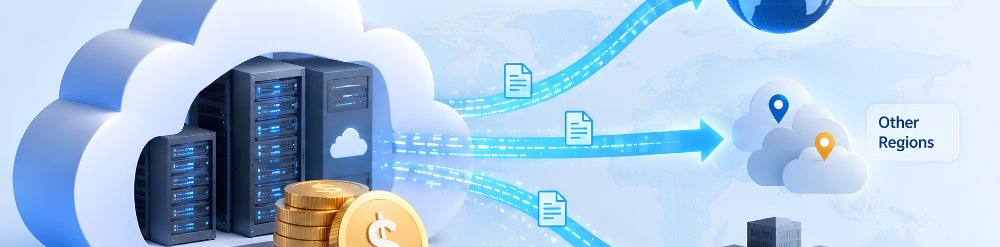
Moving to a cloud platform is a great option for organizations. It offers scalability and flexibility and improves performance. But what about data leaving the network? This is where the problem arises, and your cloud bill starts spiking.
This is where cloud egress fees come into the picture. According to Gartner reports, it could cost up to 10-15% of your total cloud expenditure. Egress is built into the background quietly across backups, API responses, and more, making it a source of hidden cloud costs. To help you understand better, here are cloud egress fees explained, along with ways to reduce them effectively. Let’s run down..
Cloud Egress Fees Explained in Short
Cloud egress fees are the charges cloud providers apply when data leaves their network environment. This may include transfers to the public internet, to a different cloud vendor, to a CDN origin, or to an on-premises data center. Cloud providers vary in how and how much they charge for data transfer costs.
Data moving from one region to another is charged based on the number of gigabytes sent. Depending on how your infrastructure is designed, they can become an important part of your monthly cloud bill and a major obstacle to switching providers, adopting a multi-cloud egress strategy, or optimizing performance.
The Cloud Cost Surprises
Egress fees do not just add to your bill. They can lead to 15% of total cloud spending for most businesses. A new study found that 62% of IT leaders exceeded their cloud budgets. Unexpected egress fees were a real reason. However, the real cost goes beyond finance; it can impact strategic decisions.
This is a hidden aspect of cloud economics that can take different forms. Cloud providers track and meter network traffic moving from one location in their clouds to another, from region to region, zone to zone, or even one virtual network to another in the same region.
Cloud data transfer is mainly divided into three categories:
- Ingress: Data entering the cloud.
- Egress: Data moving out of the cloud.
- Internal transfer: Data moving between services, availability zones, and regions based on the provider and architecture.
To take an example: While egress refers to data moving out of a system, ingress refers to data entering a system. When you download something, you’re egressing data from a cloud or data center. When you upload something, you are ingressing data to that environment.
Why Do Cloud Providers Charge Data Egress?
Cloud providers charge for data egress to recover the infrastructure costs associated with building large networks within their data centers. This can cost millions of dollars. One example is Microsoft in 2017, when the company built a 4,104-mile undersea cable between the US East Coast and Spain, reflecting investments in large-scale infrastructure to connect its data centers.
Cloud providers invest to ensure network continuity, and egress fees support those investments. Even though cloud egress fees can be frustrating, they are part of the cost organizations should pay to take advantage of public cloud infrastructure.
Factors that Increase Cloud Egress Fees
The following are some important factors that can increase egress costs.
- Volume: The amount of data you transfer out of the cloud significantly influences your egress costs. Most cloud providers use a tiered pricing model, with the first few gigabytes free or relatively cheap.
- Multi-cloud connectivity platforms: This gives you direct connections to multiple clouds through a single interface. You avoid egress fees, gain flexibility, and eliminate single-provider dependency.
- Cross-region transfers: Applications that operate across geographic regions may move data between regions. Depending on the provider and architecture, these transfers can incur additional charges.
- Data-heavy applications: AI applications, video platforms, scientific workloads, and content-heavy applications generate high outbound traffic.
Cloud Providers Egress Pricing
Transfer data to another cloud platform? You need to pay. Move it back to premises? You need to pay. Below is the standard cost breakdown:
| Cloud Provider | Egress Price (per GB) | Tier or notes |
| AWS | $0.09 | First 10 TB/month |
| Google Cloud | $0.12 | First 1 TB/month |
| Azure | $0.087 | First 5 TB/month |
| Oracle Cloud | $0.085 | First 10 TB/month |
-
- Calculation Examples: 1 TB, 10TB, 50 TB
- 1 TB (1,000 GB) → 1,000 × $0.09 = $90/month
- 10 TB (10,000 GB) → 10,000 × $0.09 = $900/month
- 50 TB (50,000 GB) → 50,000 × $0.09 = $4,500/month
Best Practices for Egress Fees Reduction
If you’re adopting cloud services, minimizing your egress fees should be your topmost priority. Below are some of the important points that you need to consider:
- Monitoring data flows: Visibility is the very first step to control.
- Keep an eye on storage tiers: Cheaper storage comes with higher egress fees.
- Make use of a CDN: Cache frequently accessed data closer to users to reduce repeated data transfers from original storage.
- Consolidate regions: Keep computing and storage in the same region to minimize inter-region fees
- Choose cloud services carefully: Many cloud services, even in the same cloud provider, offer different ways to get the same functionality. Organizations should price every approach, including network charges, which can vary enormously.
- The simplest way to cut egress costs is to transfer less data. Different techniques do this without losing any information.
Wrapping It Up!
Cloud egress fees are becoming highly important as enterprises adopt multi-cloud architectures, distributed applications, and data-intensive AI workloads. They are not going anywhere. But you have options. Companies that control their cloud costs cannot fight egress fees with strategies alone.
The main challenge is that a growing user base can create more downloads, synchronization, API calls, analytics activity, and AI processing. As all of these interactions increase, the amount of data leaving cloud environments also increases. Thus, there comes a need for cloud cost optimization that isn’t just about how much infrastructure you run. It is also about how much data your infrastructure moves and how many times it moves it.
To check out more informative blog posts around the tech landscape, don’t miss out on visiting our website.
FAQs
1] What are AWS egress fees?
Answer: AWS charges data egress on a tiered basis starting at $0.09 per GB after your free monthly allowance.
2] What are some of the biggest hidden egress cost drivers?
Answer: Some of the hidden costs include poor CDN caching, excessive log exports, oversized API responses, and more.
Recommended For You:
AWS: Organizational Cloud Adoption Framework overview
How GreenOps Is Transforming Cloud Cost Management
Exploring the Cloud Cost Optimization Strategy and Best Practices