
Every cloud application, AI model, and digital service depends on data centers. This eventually increases the demand for cloud resources and energy. According to International Energy Agency (IEA) data, data centers consume approximately 1.5% of global electricity consumption. Electricity demand of data centers is projected to double to 945 TWh by 2030 as cloud computing and AI adoption expand.
As enterprises continue to expand their cloud environments, managing cloud resources has become complex. At the same time, balancing cloud cost optimization with sustainability objectives has become even more difficult. This creates the need for an approach that balances both challenges.
GreenOps cloud cost management is an approach that helps organizations reduce environmental impact and optimize cloud costs. It mainly focuses on improving resource efficiency to drive sustainability along with financial optimization.
Let us explore how GreenOps is transforming cloud cost management, as we will dive into this topic in depth and understand its impact, strategies, and benefits.
What is GreenOps?
GreenOps (Green Operations) is a practical approach to managing cloud workloads that integrates sustainability as a core consideration. It helps organizations monitor cloud resource usage and make informed decisions throughout the cloud lifecycle.
The core objectives of GreenOps include:
- Optimize cloud resource utilization
- Minimize unnecessary energy consumption
- Reduce carbon emissions from data centers
- Support sustainable cloud decision-making
- Reduce cloud resource waste
Why Traditional Cloud Cost Management Falls Short
The basic objective of traditional cloud cost management is to control cloud expenses. As organizations scale their cloud environments, one of the major challenges they face is a lack of visibility into resource usage. Without continuous monitoring, organizations may struggle to understand how cloud resources are being consumed.
Another common issue is that businesses often allocate more computing capacity than required, resulting in more unused resources that increase cloud spending and contribute to unnecessary energy consumption.
How GreenOps is Transforming Cloud Cost Management?
GreenOps cloud cost management helps businesses understand how cloud resources are used and how to optimize them for higher efficiency and less adverse environmental impacts, rather than focusing only on minimizing operational expenses.
Continuous monitoring and visibility are two important aspects that enhance cloud cost management. This allows businesses to track resource utilization, identify inefficiencies, and make data-driven decisions to enhance cloud operations.
It also helps reduce cloud waste by identifying idle, unused, and overprovisioned resources. Organizations can optimize workloads and ensure they only pay for what they need.
Another important transformation is integrating sustainability into cloud optimization strategies. GreenOps helps lower operational costs while minimizing the environmental impact of cloud operations.
Through this approach, GreenOps enables businesses to build cloud environments that are more efficient, cost-effective, and aligned with long-term sustainability goals.
Key Benefits of GreenOps Cloud Cost Management
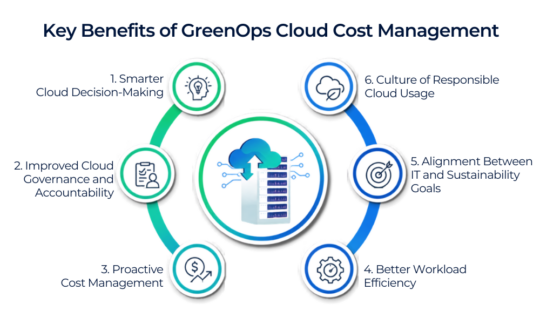
Smarter Cloud Decision-Making
GreenOps cloud cost management helps teams make effective choices about workload distribution, scaling, and infrastructure planning by providing enterprises with data-driven insights for resource utilization.
Improved Cloud Governance and Accountability
GreenOps cloud cost handling improves cloud usage. It helps in strengthening accountability by monitoring resource utilization, cloud costs, and sustainability metrics. Alongside, it also helps teams to gain optimized visibility into cloud operations and make better decisions that align with both environmental and business objectives.
Proactive Cost Management
GreenOps cloud cost control allows organizations to identify potential inefficiencies early and prevent unnecessary spending before unexpected cloud bills occur.
Better Workload Efficiency
GreenOps cloud cost optimization helps organizations analyze workload patterns. As a result, applications run more efficiently, improving performance while maintaining cost control.
Alignment Between IT and Sustainability Goals
By aligning cloud operations with sustainability goals, GreenOps enables technology teams to support environmental responsibility while achieving business growth objectives.
Culture of Responsible Cloud Usage
GreenOps encourages teams to adopt responsible cloud practices that embed cost awareness, efficiency, and sustainability into everyday operations.
Best Practices for Implementing GreenOps Cloud Cost Management
Regularly Review and Improve Cloud Strategies
Cloud environments are ever-changing. To find new optimization opportunities, organizations should consistently monitor performance, costs, and sustainability statistics.
Use Automation for Cloud Optimization
Automation can help with workload scheduling, scaling, and resource adjustments based on demand, reducing manual effort and improving consistency.
Adopt Cloud Resource Lifecycle Management
Organizations should create processes for provisioning, scaling, and retiring resources. Managing resources throughout their lifecycle prevents unnecessary consumption and improves efficiency.
Some Real-world Use Cases
Carbon-Aware Workload Management
Based on energy availability and environmental impact, businesses can use the GreenOps cloud cost management approach to adjust or relocate workloads. Companies can reduce their carbon footprint by running tasks when energy sources have lower carbon emissions.
Cloud Resource Rightsizing
Many organizations use cloud resources without specifying their exact requirements. With cloud cost management, organizations can select the right-sized infrastructure, improve application efficiency, reduce cloud expenses, and use resources more sustainably.
Idle Resource Elimination
Cloud environments often contain many unused virtual machines and inactive databases. These idle resources consume significant amounts of electricity and increase cloud costs without providing any business value. GreenOps cloud management helps organizations identify and remove or shut down unused resources, reducing unnecessary spending while lowering energy consumption and carbon emissions.
GreenOps Cloud Cost Management Tools and Platforms
Implementing GreenOps cloud cost management is not just about adopting the right strategies. Organizations also need tools that provide clear insights into cloud resource usage, cloud spending, and their environmental impact.
Google Cloud Carbon Footprint
Google Cloud Carbon Footprint helps organizations reduce carbon emissions associated with their Google Cloud workloads. The tool provides emission data across cloud projects. This enables businesses to measure their environmental impact. It also supports carbon accounting and ESG (Environmental, Social, and Governance) reporting.
AWS Customer Carbon Footprint Tool
AWS Customer Carbon Footprint Tool (CCFT) is an AWS sustainability service. The tool allows organizations to measure, monitor, and report estimated carbon emissions from their AWS cloud workloads. It provides data-driven insights into greenhouse gas (GHG) emissions associated with AWS resource usage.
Final Takeaway
As organizations grow their cloud infrastructure, they require strategies that enhance resource efficiency and align with long-term business goals. GreenOps cloud cost management enables organizations to monitor, analyze, and optimize cloud resource utilization, thereby reducing energy consumption and carbon emissions. By fostering greater accountability and operational efficiency, GreenOps supports both improved organizational performance and environmental sustainability.
For more such valuable insights please visit our official website now!
FAQs
1. How does GreenOps complement FinOps practices?
Ans: GreenOps and FinOps both aim to improve the use of cloud resources, but they focus on different outcomes. FinOps primarily focuses on financial accountability, cost visibility, and maximizing the value of cloud investments. GreenOps extends these efforts by incorporating sustainability considerations, including reduced energy consumption and more efficient resource use.
2. Can GreenOps be integrated into DevOps workflows?
Ans: Yes, GreenOps can be seamlessly integrated into DevOps workflows by embedding efficiency and sustainability considerations into the software development lifecycle.
3. Can GreenOps cloud cost management help organizations identify hidden cloud costs?
Ans: Yes. GreenOps cloud cost management provides greater visibility into cloud environments, helping organizations uncover hidden costs that often go unnoticed. These may include idle virtual machines, unused storage volumes, inactive databases, duplicate resources, and forgotten backups.
Related Reads:
Introducing the Best Multi-cloud Data Management Practices to Follow
Exploring the Cloud Cost Optimization Strategy and Best Practices