Large language models have gained strong popularity in the field of artificial intelligence. They can produce content, answer questions, and automate complex processes in a new way.
But versatility is not the only feature required by organizations; they need systems that deliver accurate outcomes, have a deeper understanding of the relevant field, and provide relevant information. As a result, domain specific language models have emerged as a strong alternative to general–purpose LLMs.
According to Gartner reports, more than 50% of development costs are reduced compared with generic large language models. For this reason, its net revenue is predicted to reach up to 131 billion dollars by 2035.
We will now examine domain specific large language models in depth to develop a comprehensive understanding of where they outperform LLMs.
Exploring Domain Specific Language Models
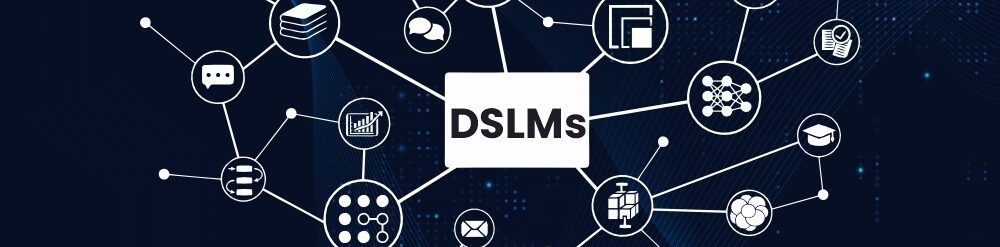
Domain specific language models (DSLMs) are specialized artificial intelligence models. These models are designed and trained to master a particular domain or perform tasks within a specific application domain. DSLMs differ from LLMs (large language models) as they are trained on datasets designed for specific use cases.
DSLMs are widely used in organizations because they are designed to produce high-quality, more precise, and reliable outputs for a particular domain. These models help improve understanding of domain-specific terminology and context, resulting in more precise responses and better task performance.
For instance, DSLMs are used in the finance, tax, and legal domains because they support financial analysis and monitoring and identify inconsistencies in financial data. They are particularly helpful in domains operating under strict regulatory and compliance standards.
Domain Specific Language Models vs Generic Large Language Models
Understanding the difference between domain-specific language model and generic large language models.
Generic Large Language Models |
Domain Specific Language Models |
| Are trained more broadly and in broader framework | Are trained and focused on specific fields or industries. |
| Accuracy may vary in highly specialized tasks | Often delivers higher accuracy within its target domain |
| Require larger and more diverse training data sets | Can be optimized using focused domain-specific datasets |
| Lack of deep domain understanding and has only a general understanding | Deep understanding of domain language and has expert level and context-rich understanding |
| Suitable for a wide range of applications | Designed to support industry-specific workflows |
Why Does the Domain Specific Language Model Outperform Large Language Models?
The major advantage of using DSLMs is that they are trained to focus on a specific field, industry, or knowledge area. Generally, LLMs are designed to handle a wide range of subjects, whereas domain specific language models are streamlined to understand the specifications, terminology, and workflows of a particular domain.
Subsequently, a domain-specific approach allows for the delivery of outputs that are synchronized with industry requirements. Many factors contribute to delivering optimum performance; these are as follows:
- Deeper understanding of the domain: Domain specific LLMs have extensive knowledge in domain-specific areas such as finance, medicine, law, or manufacturing. Therefore, these models can better understand the context and requirements, producing outputs that are better suited to them.
- Improved Accuracy and Contextual Awareness: Domain-specific precision is important because it significantly affects regulatory processes and operational decisions that often depend on highly accurate information. Models can interpret information more effectively by making use of recent interactions and domain-specific knowledge.
- Compliance and traceability: Traceability is the ability to link every requirement, decision, or output back to its source. It is an important tool for managing compliance in industries operating under strict regulatory frameworks. As a result, they can better support compliance processes and regulatory reporting.
- Greater precision in task execution: DSLMs have a thorough understanding of performing specialized tasks such as document analysis, compliance reviews, and technical assessments. They can process complex information more effectively than general-purpose LLMs. Thus, this results in significantly fewer errors and greater precision, thereby boosting productivity.
After understanding why domain-specific models outperform general-purpose LLMs, let us now explore where these models are best demonstrated.
Sectors Where Domain Specific LLMs Demonstrate Superior Performance
- Healthcare: Within the context of medical assistance, domain-specific language models are fine-tuned on medical reports, experimental studies, research papers, and medical health information. These data sources help models retain domain expertise in medicine, thereby increasing the precision of their responses. Also, enabling them to provide more precise insights and support decision-making in complex healthcare scenarios.
- Finance: Domain-specific models in the financial services sector are trained using financial reports, market data, regulatory documentation, and banking data. This specialized training enables the model to understand fraud detection, compliance monitoring, and risk management, and to function accordingly. Domain specific LLMs are useful to perform specific banking processes, for example, to detect financial fraud and for financial analysis. They produce more accurate results while complying with regulatory requirements.
- Cybersecurity: With the help of DSLMs, organizations can adopt a dynamic cybersecurity approach. Domain-specific models leverage extensive domain knowledge, security reports, threat intelligence feeds, vulnerability databases, malware analyses, and incident records. Hence, they can be used to identify threats, track weaknesses, respond to security events, and monitor unusual activity. As a result, organizations can improve overall cyber resilience.
Key Takeaways!
As we know, when it comes to the artificial intelligence, domain specific language models are proving to be the best and most valuable. Large language models are built to handle a variety of tasks, whereas domain specific LLMs are optimized for a particular domain. Rather than being trained across countless topics, DSLMs develop deeper expertise within a specific domain and address complex challenges with greater precision.
Head over to our official website for more such blogs and learning resources.
FAQs:
Q: In what ways do DSLMs differ from general-purpose language models?
Ans: DSLMs are trained on domain-specific data, used for domain-specific tasks, and generate more accurate outputs. Whereas general-purpose language models are trained on diverse data and are more versatile but less precise in specialized domains.
Q: What are the advantages of using DSLMs?
Ans: DSLMs provide several advantages, including
- Improved accuracy in domain-specific tasks.
- More relevant and reliable outputs.
- Enhanced decision-making support.
- Allows customization to suit industry-specific applications.
Q: Are DSLMs cost-effective for businesses?
Ans: Yes, DSLMs are cost-effective for businesses in the long term as they are more efficient, more precise, and effectively reduce manual workload.
Recommended For You:
SLMs to Takeover LLMs? The Biggest Shift in AI Models
Agentic AI vs Generative AI: A Comparison in Detail
A Rundown of Top 5 Machine-Learning Trends Shaping 2025 and Beyond