
OpenAI has announced the end of its AI social video app Sora, just six months after its launch. Initially, it went viral as a platform for generating hyperreal videos using artificial intelligence (AI). But later, the app raised concerns regarding deepfakes, ethical, and legal usage. It was positioned as an AI-first alternative to TikTok, which created videos using its Sora 2 model.
OpenAI confirmed the shutdown in a social media message on X saying, “We’re saying goodbye to the Sora app.”
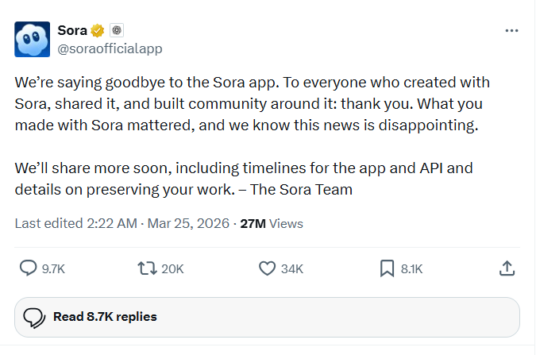
However, OpenAI did not share the main reason behind the shutdown and did not share when it would be closed completely.
The Rise of Deepfake Concerns and Identity Risks
Even though the app became popular for AI-generated video content, it also gave rise to unignorable risks, such as the spread of deepfakes. It allowed users to generate realistic videos using simple text prompts. This also created concerns among experts, academics, and advocacy groups who said it was a danger leading to nonconsensual images and deepfakes.
Sora's core feature called “cameo,” which was later renamed as “characters.” This allowed users to create scan their faces, upload photos, and create deepfake, AI-generated videos. However, this feature was misused. Users could bypass safeguards, and generate deepfakes of renowned public figures including Sam Altman, Martin Luther King Jr, and Michael Jackson.
This raised issues regarding user identity. Individuals for both public and private users could be manipulated without consent increasing the risk of reputation harm, and impersonation.
Regarding the Copyright Challenges
After the risks to users, it shifted gears towards copyright violations. The platform stood as a hub for AI-generated content featuring characters such as Mario, Naruto, and Pikachu, raising legal issues for OpenAI. Thus, as misuse grew, the legal and reputation risks became difficult for Sora to sustain.
Early Success but a Significant Shift
Sora initially made a buzz in the AI industry. The download rates reached new heights, with 3.3 million downloads across iOS and the Google Play Store in November. However, in February, the engagement went down drastically to 1,128700 downloads, making it a point of concern for OpenAI. Considering the massive number of users of ChatGPT, the app failed due to its rising security risks, identity misuse, copyright issues, and more.
The strategic decision by OpenAI to shut down the Sora app clearly shows it moving away from experimental, risky AI video social platforms toward controlled AI deployments. Moreover, even though this app is discontinued, OpenAI’s Sora 2 is still available.
Don’t miss out on the latest news headlines! Visit our website now and explore more!
Recommended For You:
OpenAI Introduces GPT Image 1.5: A Sophisticated Image Generation and Editing Model