

If you are building a modern app, you need a database that can keep up with growing workloads without risking security or stability. Traditional development approaches often struggle with memory management and concurrency as systems grow more complex. Rust offers a different approach.
Rust Database Development combines low-level performance with strict memory safety. It helps engineering teams build database-driven applications that can manage high traffic and complex data operations with fewer runtime risks.
But Rust is not just another fast programming language. Its real advantage lies in how it handles resources and prevents common programming errors before an application reaches production.
Let's explore how Rust is changing database development and where it makes the most practical difference.
Why Rust Is Becoming a Strong Choice for Database Development
Database applications do more than just storing and retrieving information. They also handle concurrent requests, maintain data consistency, and communicate with external services. Rust addresses several application-layer challenges.
Its ownership system controls how memory is accessed and released. Developers do not need a garbage collector to manage memory. The compiler checks ownership rules and prevents many memory-related errors.
Your app handles concurrent database traffic without wasting an operating system thread on every request.
Current industry data shows this shift in action. According to the 2025 State of Rust survey, 51.7% of respondents use Rust for backend services in their companies while 10.5% use it for database systems.
This data confirms that Rust is now a go-to choice for backend and database teams.
How Rust Improves Database Application Performance
Database performance depends on several factors. Query execution, network latency, connection management, and application overhead all influence response times.
Rust makes your application code run faster and use fewer resources.
1. Efficient memory management
Without a garbage collector, Rust avoids unpredictable garbage-collection pauses. Consistent memory behavior makes a huge difference when an app processes large datasets or handles nonstop traffic.
2. Asynchronous database operations
A slow database query should never stall the rest of your application.
Rust's asynchronous programming model allows applications to handle multiple I/O operations efficiently. Libraries such as Tokio provide the runtime needed to schedule asynchronous tasks.
SQLx supports both async runtimes and connection pooling. This makes it ideal for APIs that manage changing database workloads.
3. Reduced application overhead
Rust compiles into native machine code. Its abstractions can often be optimized without introducing significant runtime overhead.
However, faster application code does not automatically mean faster database queries. Poor indexing and inefficient joins can still create bottlenecks.
Developers should use query plans and profiling tools to identify the actual performance problem.
Memory Safety and Data Consistency in Rust Database Development
Database applications frequently process sensitive information. A memory error or poorly managed concurrent operation can create serious reliability concerns. Rust provides language-level safeguards.
Its ownership and borrowing rules prevent data races in safe Rust code. The compiler also checks whether references remain valid throughout their use.
This is especially useful when multiple application components access shared database-related data.
For example, an online payment platform may process account balances while handling multiple requests. Developers must prevent conflicting updates and ensure that transactions preserve business rules.
Rust helps control access to application data. Database transactions still handle atomicity and consistency.
This distinction is important. Rust does not replace database constraints or transaction management. It provides additional protection around the application logic that interacts with them.
Choosing the Right Rust Database Libraries
The Rust ecosystem offers a range of database tools. The right choice depends on query complexity, architecture, and development requirements.
SQLx for Asynchronous Database Applications
SQLx is an asynchronous SQL toolkit. It supports PostgreSQL, MySQL, and SQLite.
Its compile-time query macros can validate SQL statements against a development database. This helps catch invalid queries and type mismatches before runtime.
SQLx is particularly useful for API backends and services that require direct SQL control.
Diesel for Type-Safe Database Queries
Diesel is an ORM and query builder designed around Rust's type system.
It provides compile-time checks for query construction. This reduces errors when working with database schemas and complex relationships.
It suits applications where developers prefer structured query building and strong schema-level guarantees.
SeaORM for Entity-Based Development
SeaORM provides an asynchronous ORM approach.
It uses entities to represent database tables and simplifies common operations involving relationships and data models.
It can be useful for teams that prefer working with application models rather than writing SQL for every database operation.
Practical Applications of Rust in Database Development
Rust offers value in applications where resource efficiency and reliable data processing matter.
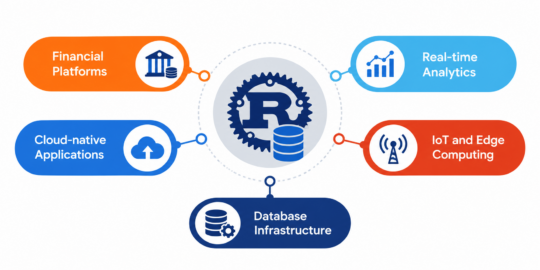
Financial platforms: Payment services and transaction systems require steady speed and safe parallel processing. Rust makes your application-side transaction logic much more reliable.
Real-time analytics: Applications that process continuous event streams can use Rust for efficient ingestion and transformation before storing data.
Cloud-native applications: Microservices often handle large numbers of network requests. Rust's asynchronous ecosystem supports services that need efficient database communication.
IoT and edge computing: Devices frequently operate with limited memory and processing capacity. Rust can support lightweight applications that collect and store sensor data.
Database infrastructure: Rust is also well-suited for building storage engines, query-processing components, and distributed data systems where resource control matters.
What Developers Should Consider Before Adopting Rust
Rust has clear engineering advantages, but adoption requires planning.
There is a learning curve. Developers who normally work with garbage-collected languages often need time to learn ownership, borrowing, and lifetimes.
Database library selection also matters. Rust does not have one universal ORM that fits every project.
Another consideration is query performance. Choosing Rust will not fix an inefficient database schema or missing indexes.
Every reliable setup should cover these essentials:
- Connection pooling with sensible limits.
- Parameterized queries for user-supplied values.
- Database migrations for controlled schema changes.
- Transaction boundaries that reflect business requirements.
- Query profiling and load testing.
- Monitoring for connection failures and slow queries.
These practices help turn Rust's language-level advantages into measurable application improvements.
Is Rust the Right Choice for Your Next Database Project?
Rust Database Development is the right call when your app serves heavy user traffic and needs to avoid slowdowns or crashes.
If you are building a simple CRUD app with light traffic, a traditional garbage-collected language will likely get you to market faster with less upfront complexity. Your choice should come down to real system bottlenecks, not programming trends.
When your architecture demands strict resource control and rock-solid query execution at scale, this offers a clear engineering advantage.
Final Takeaway
Rust is not suited to every database project. It makes the most sense when data operations are central to the product, and errors carry serious consequences. Rust Database Development gives teams greater control over error handling, query validation, and resource usage.
The decision should depend on your application's actual requirements. For transaction-heavy platforms and data-intensive services, Rust can provide a strong foundation for building reliable database systems.
To read more such tech related topics, head over to our website now.
FAQs
Q1. Does Rust support both SQL and NoSQL databases?
Ans: Yes. You can connect Rust to SQL databases (PostgreSQL, MySQL, SQLite) and NoSQL stores (MongoDB, Redis) using dedicated drivers and libraries.
Q2. Can developers use Rust along with other backend programming languages?
Ans: Yes, developers can easily use Rust alongside backend languages like Python, Java, Node.js, or Go.
Q3. Can you write raw SQL in Rust without using an ORM?
Ans: Yes. You can skip ORMs completely and write raw SQL in Rust. Popular tools like SQLx and Rusqlite let you run standard SQL queries while still catching typos and data mismatches before your code runs.
You May Also Like:
Role of Two Phase Commit Protocol in Database Management
What Are Attributes? Different Database Attributes Types with Examples
What Is a Time Series Database? Why Regular Databases Struggle with Timestamped Data