Are you aspiring to become a deep learning engineer? Have you ever googled what skills are required to get a job as a deep learning engineer? You will find numerous websites listing programming languages, mathematical concepts, machine learning techniques, and AI tools.
In the last few years, knowing only the basics of AI has been enough to differentiate oneself in the job market. However, in 2026, many companies are hiring candidates with knowledge of these concepts and hands-on experience in deep learning frameworks. Companies are looking for candidates with real-world experience applying AI frameworks, not just knowledge of the underlying concepts.
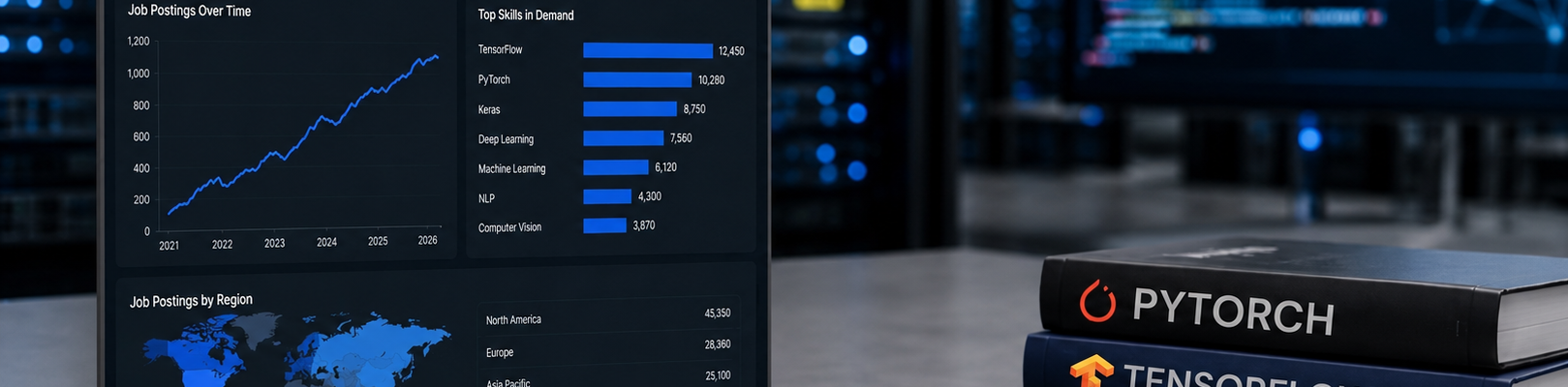
Among the many technical skills employers seek expertise in are PyTorch, TensorFlow, and Keras. These are among the top skills to look for in a candidate for deep learning roles. They are now frequently listed as preferred or required skills across many AI job descriptions. Around 40% of job listings require AI skills.
But which framework is creating the strongest career opportunities? Does mastering one framework improve your chances of getting hired, or do you need to gain experience with multiple tools?
In this blog, let's explore how deep learning frameworks are shaping AI hiring trends in 2026. This blog now compares not only the demand for PyTorch, TensorFlow, and Keras but also explains how competitive these skills are in today's AI job market.
How are AI Hiring Trends Changing in 2026?
In 2026, AI hiring trends have drastically changed the way organizations hire candidates, as they increasingly use AI to find better matches and reduce manual work.
Below are some of the major changes that took place in the hiring process:
1. AI is becoming a hiring assistant
Back in the day, recruiters had to read stacks of resumes manually. But this manual process is overtaken by AI tools. Because AI tools can now
- Scan resumes quickly.
- Find candidates with matching skills.
- Schedule interviews automatically.
- Answer candidate questions through chatbots.
2. Skills matter more than degrees
Companies are focusing on skills, practical knowledge, and problem-solving abilities rather than solely on degrees or job titles. Recruiters use AI tools to identify candidates based on:
- Actual skills
- Projects they have completed
- Certifications
- Work experience
- Problem-solving ability
3.AI interviews and assessments are increasing
The recruitment process is changing as companies use digital tools to understand candidates’ skills and abilities better.
- Online skill tests
- Coding assessments
- Video interview analysis
- Interactive work assessments
How Deep Learning Frameworks Outperform AI Hiring?
Deep learning frameworks hiring trends show a clear shift in what employers expect from AI professionals. Earlier, having only basic knowledge was sufficient to secure a job in the market. But today, several organizations work with AI; hence, recruiters are prioritizing professionals with practical experience with frameworks such as PyTorch, TensorFlow, and Keras.
Professionals who understand which framework to use, when to use it, and why it fits a particular business problem are better prepared to meet today's AI hiring requirements. Candidates with practical knowledge fit into the AI project quickly will need only minimal additional training, enabling them to contribute immediately.
Organizations do not consider this framework knowledge an extra technical skill; they view it as proof that the candidate can build real AI applications using industry-standard tools. This framework expertise helps candidates stand out because it demonstrates the following qualities that employers actively look for:
1. Demonstrate hands-on experience in building real-world AI applications.
2. Reduces the learning curve, allowing you to contribute to AI projects more quickly.
3. It opens the door to advanced AI jobs that require specialized knowledge and practical skills.
4. Introduces you to the world of advanced AI applications like computer vision, natural language processing (NLP), and generative AI.
PyTorch vs TensorFlow vs Keras: Which Framework Fits Your Career Path?
Selecting the right deep learning framework depends on your career goals. You should be familiar with the type of applications you want to develop and the industry you plan to work in. PyTorch, Keras, and TensorFlow are each preferred for different roles, industries, and business requirements.
Before investing your time in learning a framework, it is essential to understand where it is used, the career opportunities it offers, and the type of AI projects it supports. The table below compares the three frameworks that employers and AI professionals commonly consider.
| Feature | PyTorch | TensorFlow | Keras |
| Best suited for | AI research, Generative AI, NLP, Computer Vision | Enterprise AI, production systems, Cloud applications | Learning deep learning and rapid prototyping |
| Learning curve | Moderate | Moderate to Advanced | Beginner-friendly |
| Ease of use | Flexible and intuitive | Comprehensive but more complex | Simple and easy to understand |
| Industry adoption | Widely used in research labs and AI startups | Widely adopted by enterprises and large organizations | Popular for education, experimentation, and prototyping |
| Deployment capabilities | Good | Excellent across cloud, mobile, and edge devices | Limited compared to TensorFlow |
| Typical job roles | AI research Engineer, Deep Learning Engineer, NLP Engineer | Machine Learning Engineer, AI Engineer, MLOps Engineer | AI/ML Beginner, Junior AI Developer |
Each framework offers unique strengths depending on the project's requirements. These frameworks support diverse career opportunities.
Which Deep Learning Framework Should You Learn in 2026 Based on Your Career Goal?
There is no single framework that will guarantee better job opportunities. The best choice depends on the career path you want to pursue. Instead of mastering multiple frameworks at the beginning of your journey, focus on developing strong practical skills in one framework.
PyTorch: Ideal for AI Research and Generative AI Careers
PyTorch is a strong choice if your goal is to work on advanced AI technologies such as large language models (LLMs), computer vision, or natural language processing (NLP).
Choose PyTorch if you want to:
- Build generative AI and LLM applications.
- Pursue careers in AI research or innovation.
- Develop advanced computer vision or NLP solutions.
TensorFlow: Best for Enterprise AI and Large-Scale Applications
TensorFlow is useful for people who want to build AI systems for large companies. It helps developers build AI applications that can work on different platforms, such as computers, mobile phones, and cloud systems.
Choose TensorFlow if you want to:
- Build scalable AI applications for businesses.
- Work on cloud, mobile, or edge AI solutions.
- Join organizations that prioritize enterprise-grade AI systems.
Keras: The Best Starting Point for Beginners
Keras is a beginner-friendly deep learning framework for ambitious AI professionals. It's a user-friendly interface that helps develop foundational AI skills and an understanding of core deep learning concepts very easily. Beginners can quickly create and test AI applications before moving on to more complex frameworks and advanced AI development workflows.
Choose Keras if you want to:
- Learn deep learning with minimal complexity.
- Build and test AI models quickly.
- Strengthen your understanding of neural networks.
Top AI Job Roles that Require Deep Learning Framework Skills
Framework expertise has become a valuable requirement for many AI job roles. Understanding which job roles commonly require these skills can support you in aligning your learning path with current deep learning frameworks hiring trends.
| AI Job Role | Commonly Used Framework | Key Responsibility |
| AI Engineer | PyTorch, TensorFlow | Design, develop, and deploy AI-powered applications |
| Machine Learning Engineer | TensorFlow, PyTorch | Build, train,optimize, and maintain machine learning models |
| Deep Learning Engineer | PyTorch, TensorFlow | Develop deep neural networks for complex AI applications |
| Computer Vision Engineer | PyTorch | Create image recognition object detection, and video analysis solutions |
| AI Research Scientist | PyTorch | Research and develop innovative AI models and algorithms |
The demand for these roles is growing across industries such as healthcare, finance, manufacturing, retail, automotive, and cybersecurity. Professionals who gain hands-on experience through internships often have a relative advantage during the hiring process.
Want to Get Hired? Master These AI Skills in 2026
In 2026, employers are seeking candidates who can combine framework knowledge with programming, machine learning concepts, and cloud technologies. As a result, mastering deep learning frameworks is necessary to build a successful AI career.
To remain competitive in today's AI job market, in addition to framework knowledge, candidates should also focus on developing the following skills:
Python programming: The primary language used for developing deep learning and machine learning applications.
Machine Learning and Neural Network Fundamentals: A strong understanding of unsupervised and supervised learning, as well as neural networks, is essential for building effective AI solutions.
Large Learning Models (LLMs) and Generative AI: Familiarity with modern AI technologies is increasingly valuable as organizations integrate generative AI into their products and services.
Data preprocessing and feature engineering: Generating high-quality data is necessary for developing precise and reliable AI models.
Model deployment and MLOps: Employers value professionals who can deploy, monitor, and maintain AI models in production environments.
Cloud platforms and version control: Knowledge of cloud services such as AWS, Azure, or Google Cloud, along with Git and GitHub, supports collaboration and scalable AI development.
Mastering these essential skills, along with practical experience, prepares candidates to meet the requirements reflected in deep learning frameworks and hiring trends for AI and machine learning roles.
Conclusion
Deep learning frameworks have become more than development tools. They are now an important consideration in AI recruitment and career development. Employers increasingly seek professionals who can translate theoretical knowledge into practical solutions using industry-standard frameworks. Rather than focusing on learning every framework, build a strong foundation in the one that best aligns with your career aspirations and strengthen your expertise through hands-on projects and continuous learning. Combining framework proficiency with broader AI skills and practical experience will help you adapt to changing deep learning frameworks hiring trends and prepare you for long-term success in the evolving AI job market.
For more such information please visit our official website now!
FAQs
Q. How to improve chances of getting hired for AI roles?
Ans: Below are some methods mentioned that will help improve your chances of getting hired:
- Develop hands-on projects,
- Build a strong portfolio,
- Contribute to open-source projects when possible,
- Strengthen your programming and AI fundamentals, and
- Gain practical experience with industry-standard deep learning frameworks.
Q. Is PyTorch better than TensorFlow for AI jobs?
Ans: It's impossible to state which framework is superior. PyTorch is commonly used for AI research, computer vision, NLP, and generative AI, while TensorFlow is widely adopted for scalable enterprise AI applications. The better choice depends on your career goals.
Q. Which deep learning framework is most in demand in 2026?
PyTorch and TensorFlow are considered as the most in-demand deep learning frameworks as they are widely used in AI research, enterprise AI development, and production environments. whereas Keras is a popular choice for beginners and rapid prototyping.
Recommended For You: