

A mortgage application creates information across several systems. The loan origination system holds application details. Credit providers supply borrower history. Appraisal services provide property valuations. After funding, servicing platforms record payments and account activity.
Cloud data platforms for mortgage lending bring this information into a managed environment. Their purpose goes beyond storing records. They help lenders process loan information, analyze business performance, and make data available to teams across the mortgage lifecycle.
How Cloud Data Platforms Work in Mortgage Lending
A cloud data platform connects different stages of data processing. Its architecture typically includes four layers.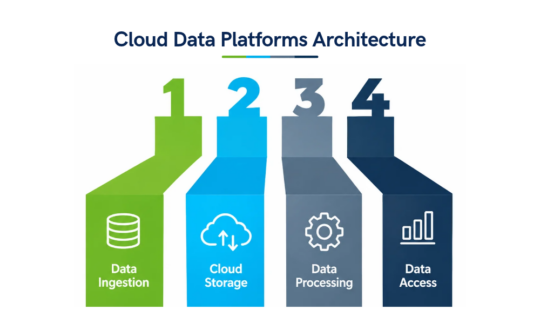 1. Data ingestion: collects information from loan origination systems (LOS), servicing applications, credit bureaus, and appraisal providers. APIs can support frequent updates, while batch transfers handle scheduled data loads. This is the foundation of mortgage data integration.
2. Cloud storage: supports different purposes. A data lake can retain raw documents and source records. A data warehouse stores cleaned and structured information for reporting. Some platforms use a lakehouse architecture to support both types of workloads.
3. Data processing: transforms incoming records into usable datasets. Pipelines can standardize formats, check missing fields, and calculate values such as loan-to-value (LTV) ratios. Cloud computing resources can also scale with processing demand, so lenders don't have to maintain all infrastructure on-site.
4. Data access: delivers approved information to dashboards, reporting tools, and business applications. Teams can use consistent datasets rather than creating separate extracts for every report.
Mortgage data mapping is another important part of processing. The MISMO Reference Model provides common data definitions and structures for mortgage business processes. Lenders can use it to map information between applications and make exchanges easier to interpret.
How Mortgage Data Analytics Supports Lending Decisions
Once information is connected and prepared, lenders can examine activity across the loan lifecycle.
For example, a lender may want to understand why approved applications do not reach closing. The LOS records application progress, while pricing systems contain rate-lock information and closing systems record outcomes. Comparing these datasets can help identify where applications drop out of the pipeline.
Other applications of mortgage data analytics include:
- Credit risk: Compare borrower characteristics with repayment patterns to support portfolio risk analysis.
- Property valuation: Examine appraisal differences across locations and property types.
- Prepayment forecasting: Study repayment trends to estimate how quickly borrowers may pay off loans.
- Delinquency monitoring: Track missed payments and identify portfolios that need closer attention.
- Operational performance: Measure processing time from application through underwriting, approval, and closing.
These insights help teams investigate trends and plan their work. They do not replace underwriting rules or professional lending decisions.
Preparing Loan Data for Investor Delivery
Mortgage data must also meet the requirements of the organizations receiving it. Fannie Mae and Freddie Mac have established the Uniform Loan Delivery Dataset (ULDD) to define the common data elements required for single-family loan deliveries.
A cloud data platform can support this process by checking delivery records before submission. Validation rules can flag missing information, inconsistent values, and incorrect formats. Staff can then review exceptions before preparing the final loan data.
This gives lenders a more consistent way to manage delivery requirements and correct data issues before submission.
Supporting the Move from Origination to Servicing
Data quality remains important after a loan is funded. When a newly originated loan enters a servicing system, the servicer needs accurate account information to set up payments and manage the loan.
MISMO's Loan Boarding Data Segment (LBDS) establishes a common baseline of data points for boarding newly originated residential mortgage loans. Published as a Candidate Recommendation in October 2025, it is based on the MISMO Version 3.6 Reference Model.
A cloud data workflow can help lenders and servicers check incoming records against the required information. This can expose missing or inconsistent details before account setup. The aim is to reduce manual mapping, correction work, and delays in activating loans.
Protecting Sensitive Mortgage Information
Mortgage records contain personal details, income information, credit history, and payment records. A cloud platform must therefore support strict controls over how data is stored and accessed.
Role-based permissions limit access according to job responsibilities. Encryption protects information at rest and during transfer. Audit logs record access and changes, while data lineage helps teams trace a reported value back to its source.
Lenders must also define retention policies and review their cloud providers' security arrangements. Moving data to the cloud does not remove the lender's responsibility to protect borrower information or meet applicable requirements.
Choosing a Cloud Data Platform for Mortgage Lending: Vendor Evaluation Checklist
| Evaluation criteria | Checklist | What to ask vendors |
| Integration | Connects with existing LOS, servicing software, and external data providers. | Can your platform integrate with our existing mortgage systems? |
| Scalability | Handles growing loan volumes, documents, and reporting needs. | Can the platform scale as our mortgage operations grow? |
| Data Quality | Supports data validation, standardization, and traceability. | How do you identify and manage inconsistent or incomplete data? |
| Security | Provides controlled access and activity monitoring. | What security controls are available to protect sensitive mortgage data? |
| Recovery | Offers reliable backup and disaster recovery capabilities. | What backup and recovery options do you provide? |
A phased migration can help test these requirements. Lenders can start with one dataset and test the full process, from ingestion to reporting, before expanding the platform.
Preparing Mortgage Data for AI Readiness
Preparing mortgage data for AI requires more than moving it to the cloud. Lenders need accurate, consistent, and accessible data to support AI applications such as credit risk assessment, fraud detection, and loan processing. Cloud data platforms help create this foundation by bringing data from different mortgage systems into a structured and usable environment.
Examples of Cloud Data Platforms and Mortgage Data Services
- Snowflake: A cloud-based data platform used to store, manage, and analyze mortgage data.
- Databricks: Supports data engineering, large-scale data processing, and machine learning workloads.
- Microsoft Fabric: Combines data integration, engineering, warehousing, and analytics capabilities.
- ICE Data Connect: Provides access to data from ICE's loan origination systems (LOS) for mortgage data integration.
Common Challenges in Implementing Cloud Data Platforms for Mortgage Lending
Mortgage lenders may encounter several challenges when modernizing their data infrastructure.
- Legacy LOS: Integrating older loan origination systems with modern cloud platforms can be complex.
- Data Quality: Inconsistent borrower information, duplicate records, and incomplete mortgage documents can affect reporting and analytics.
- Vendor Lock-in: Dependence on proprietary platforms can limit flexibility and make future migrations difficult.
- Cost Control: Cloud storage, data processing, integrations, and ongoing maintenance can increase operational expenses.
Conclusion
Cloud data platforms help mortgage lenders turn information from separate systems into data that can be processed, analyzed, and shared under controlled access. Their value goes beyond storage. They provide the foundation for better visibility across origination, loan delivery, and servicing.
The right platform fits the lender's systems, data requirements, and operational goals.
FAQs
Q. What role does metadata management play in mortgage cloud data platforms?
Ans: Metadata management helps organize mortgage data. It tells us what the data means, where it comes from, and how to use it. It makes data easy to find and manage.
Q. How do cloud data platforms support mortgage fraud detection?
Ans: Cloud platforms help find fraud by checking mortgage data. They identify wrong information, unusual activities, and suspicious transactions. This helps prevent fraud.
Q. How do cloud data platforms support mortgage securitization?
Ans: Cloud platforms help collect and organize home loan data. They group similar loans and check their details. This helps banks combine loans and sell them to investors.
Recommended Reading: