

How about getting the daily groceries you need, medicine, or even an electronic pen drive delivered to your doorstep in just 10 minutes? What once seems impossible is now a reality with the emergence of Quick commerce, or q-commerce. The concept gained momentum with Getir launched in Istanbul in 2015, and Gorillas followed Berlin in 2020. According to source, the global quick commerce market was valued at $244.7 billion in 2025 and is expected to grow from $297.5 billion in 2026 to $1,305 billion by 2033.
What once felt like convenience is now embedded in everyday life. The major shift behind this is not smart warehouses; it is the integration of artificial intelligence across quick commerce. AI now reshapes logistics, operations, and more.
In this blog, we will walk through the concept of quick commerce and how AI and automation are reshaping it. If you sell consumer products, entering the quick commerce era is a win-win!
What is Quick Commerce?
Quick Commerce, or Q Commerce, is a retail advancement where customers can expect on-demand delivery of goods like groceries, electronics, and household essentials within 10 to 30 minutes of placing an order.
While traditional eCommerce delivers goods in several days, quick commerce is designed for quick order fulfillment. The model works on three pillars:
- Dark stores or micro-warehouses: Where the goods are stored.
- A rider fleet: A network of delivery partners responsible for picking up orders.
- A software layer: A tech system that manages customer orders and inventory, assigns delivery partners, and optimizes delivery routes.
Use Cases of Quick Commerce:
- Groceries: Fruits, vegetables, and other essentials.
- Food Delivery: Ready-to-eat food.
- Daily essentials: Snacks, medicines, and more.
The main goal of quick commerce is speed, convenience, and efficiency. It depends on hyperlocal operations, where products are stored in dark stores or warehouses close to customers.
How is 10 Minute Delivery Changing Consumer Expectations?
Delivering products in 10 minutes is no small feat. This has also changed the customer's expectations. They get:
- Immediate fulfillment
- Zero waiting time
- Maximum convenience
The normal part of shopping, called patience, is no longer today. In short, speed is becoming a new part of customer experience.
How AI and Automation are Transforming Quick Commerce?
AI isn’t just improving quick commerce; it’s making it feasible.
- AI-Driven Demand Forecasting: AI algorithms can analyze different variables simultaneously, such as weather patterns, historical sales data, traffic conditions, social media trends, and more, to predict customer demand with the right accuracy. Machine learning models constantly learn and adapt to improve predictions over time. For example, during the summer season, demand for cold beverages, ice cream, etc., increases.
- Hyper-personalized Customer Experience: AI analyzes customer behavior to deliver a personalized experience that increases trust among customers and increases sales. For example, AI suggests products based on customer patterns and past purchase behavior, and sends timely notifications. Statistics show that personalization can increase repeat purchases by 35-40%.
- Real-Time Handling of Customer Queries: AI chatbots help address customer concerns through real-time chat. They can share order-related queries and get live updates in seconds. Customers can ask about order status, incorrect products, quality, and more.
- Intelligent Route Optimization: AI helps to analyze traffic, distance, and delivery priorities to know the fastest and most efficient route for deliveries. With AI-powered route optimization, drivers spend less time on the road, and deliveries can reach customers faster. Zepto has developed in-house navigation tools (Zepto Maps) to enhance delivery times.
What are the Benefits of AI-Driven Quick Commerce?
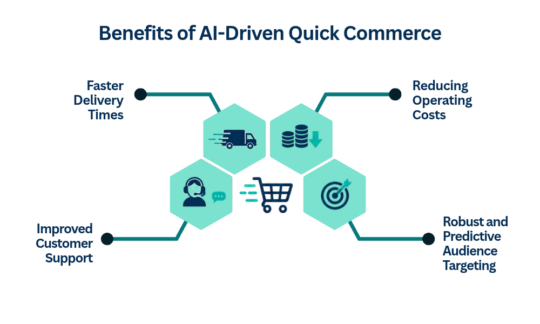
- Faster Delivery Times: AI helps reduce delivery times, enhancing customer satisfaction. Customers can get products in minutes, not days.
- Reducing Operating Costs: By optimizing inventory, routes, and other operations, AI reduces operational costs.
- Improved Customer Support: AI-powered chatbots offer instant responses to common queries, track orders, and assist customers with refunds and delivery-related issues.
- Robust and Predictive Audience Targeting: AI helps to identify high-potential customers and target them effectively.
Top Quick Commerce Examples
Blinkit
Blinkit is the go-to and most popular quick commerce platform in India. It delivers groceries, snacks, vegetables, and other household essentials in minutes. Blinkit was formerly Grofers, rebranded in 2021 and was acquired by Zomato (now Eternal) in 2022 which played a key role in bringing 10-minute delivery.
Amazon Now
Amazon offers fast and convenient grocery delivery in 5,000 U.S cities and town, with thousands of same-day delivery. The company is closing Amazon Go and Amazon Fresh physical stores, while introducing Amazon Now. Deliveries are 30 minutes or less at their doorstep and are available in parts of Seattle, Washington, Philadelphia, and Pennsylvania. Customers get several options regarding the order, delivery, and tip.
Zepto
Zepto, launched in 2021, has become one of the most-talked players in the quick commerce industry. The company offers same day groceries and daily essential needs delivery in 10 minutes or less. The ultra-fast delivery is now denoted as “instant delivery.” Zepto aims to meet the growing consumer needs at convenience.
Swiggy Instamart
Launched in 2020, Instamart is Swiggy’s fast deliveries of grocery and food. It is India’s leading quick commerce platform. Swiggy’s next-generation technology and dedicated delivery makes it possible to bring groceries and other daily essentials at doorsteps of Indian in 10-15 minutes. Swiggy Instamart is the go-to choice of customers looking to order online without much hassle.
Quick Commerce vs Traditional eCommerce: Key Differences
Below are the key differences between quick commerce and traditional eCommerce. Both models converge operationally but have different customer expectations.
| Parameter | Quick Commerce | Traditional eCommerce |
| Delivery time | 10 to 30 minutes | 1 to 3 days |
| Order frequency | 8 to 15 per month | 2 to 4/month |
| Basket size | Smaller | Larger |
| Cost per order | High | Low |
Concerns with Quick Commerce
Even though quick commerce offers a range of benefits, the rise of 10-minute delivery also brings a range of concerns. Let’s take a look at them below:
- Workforce pressure: Delivery partners work under tight timelines. They are under pressure to deliver orders as soon as possible.
- Urban congestion: Traffic issues and busy roads make it difficult for the delivery partners to meet deadlines.
- Sustainability: Increased packaging waste and delivery-related emissions can negatively impact the environment, raising concerns about the long-term sustainability of quick commerce.
- Workforce impact: Increased automation can change traditional warehouse and delivery operations, creating a need for employees to develop new tech skills.
Final Words!
Quick commerce is not just a hype. It is a structural reorganization of how consumers meet the widespread demand for everyday goods.
Quick commerce represents a shift in the retail sector, driven by AI and automation. These platforms are reshaping the flow of goods from retailers to consumers by using hyperlocal fulfillment centers, logistics networks, and data-informed demand forecasting. Businesses that embrace this technology are expected to reach new heights of success. Hope you now have a clear understanding of this 10-minute delivery.
Read more such trending blog topics on our website.
FAQs
1] What are dark stores in Q-commerce?
Answer: Dark stores are small, offline warehouses that are set up only for online orders. Customers do not visit them, but they make quick order fulfillment possible by storing fast-moving items close to the delivery zone.
2] How does AI improve grocery delivery apps?
Answer: AI helps predict demand, optimize delivery routes, personalize recommendations, and enhance operational efficiency.
3] How long does it take to implement AI in quick commerce operations?
Answer: Implementation time depends on business size and complexity; however, most organizations can see results within 3-4 months. Following a phased approach can work well.
Also Read: