

The network connectivity world is advancing rapidly. The emergence of 5G technology has significantly transformed wireless communication by delivering faster speeds, ultra-low latency, and massive device connectivity. With that being said, one concept that has captured attention is network slicing.
It's a practice that lets operators split a single 5G network into multiple virtual networks, or "slices," each optimized for specific tasks or services. Think of a highway with certain lanes: one reserved for heavy vehicles, others for everyday cars, etc. That's what network slicing does for 5G. But what exactly is network slicing, and why is it crucial for the next generation of wireless communication? Let's find out in this blog how businesses and industries can get the performance and reliability they need, tailored to their requirements.
What is 5G Network Slicing?
5G network slicing is basically the process of splitting one physical network into multiple virtual networks. This means creating separate virtual data pipelines for a specific business use case, such as location tracking. Each slice is configured for latency, bandwidth, and reliability.
Every slice shares similar infrastructure, fiber, tower, and 5G core, yet it operates as an independent, end-to-end network with tailored resources. However, it stays logically isolated from the others so the operator can track what happens on each one and set charges accordingly. 5G network slicing allows businesses to optimize bandwidth, security, and focus on access to the most important services, use cases, or customers.
Common Types of 5G Network Slice
There are three main types of network slicing for 5G technology.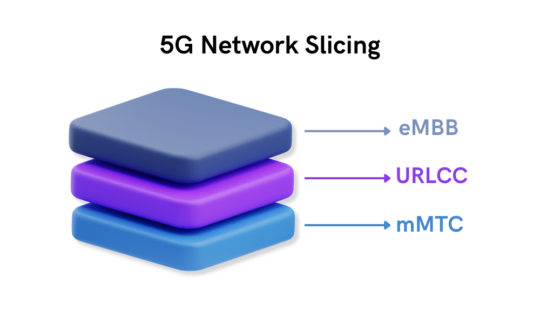
- Enhanced Mobile Bandwidth (eMBB): Enhanced mobile broadband slicing ensures 5G applications with high traffic can deliver high-quality broadband services. In works best in dense or crowded places where thousands of people and devices hit the network at once. eMBB slices are high-bandwidth type and reduce the connectivity issues or outages.
- Ultra-Reliable Low-Latency Communications (URLCC): As the name suggests, URLCC focuses on latency. It is designed for strict latency and reliability requirements where a single delayed or dropped signal can stop the system immediately. It is ideal for businesses that don’t need many resources but require higher reliability.
- Massive Machine-Type Communications (mMTC): This is one of the networking slicing types that is used to manage large amounts of interconnected devices with fewer data rates. It is ideal for IoT applications such as smart cities, connected sensors, and more.
Key Technologies Behind the Innovation
Virtualization is the key pillar that lets 5G network slicing run on shared hardware. Alongside virtualization, below are some of the key technologies involved in its successful implementation.
- Software-Defined Networking (SDN): Makes traffic control programmable, which is required for dynamic slice steering and routing.
- Network Function Virtualization (NFV): Separates communication services from dedicated hardware such as routers and firewalls.
- Orchestration: Automates slice creation, healing, and retirement across the entire network.
- Cloud-native 5G core: Uses containers and microservices so operators can deploy new functions faster and scale them independently.
How Does 5G Network Slicing Improve Performance and Reliability?
Let’s explore how network slicing improves performance and reliability for businesses.
- Better Reliability and User Experience: With 5G slicing, businesses do not suffer from poor network performance. It ensures that each slice gets the resources it needs. This reduces latency and improves the user experience. Businesses can get the bandwidth and processing capacity they need to run their applications effectively.
- Let’s look at an example: In traditional mobile networks, users share the same infrastructure so that heavy traffic can slow speeds. Network slicing reduces this issue by isolating services, so performance remains stable even during peak hours.
- Reduced Network Latency: Applications need data to travel between devices and systems with minimal delay. Network slicing supports lower latency by prioritizing critical traffic and optimizing network resources. This works best for industrial robots, connected vehicles, and real-time monitoring systems.
- Optimized Performance: With network slicing, telecom operators can create multiple virtual networks (slices), and each slice is tailored for a specific use case, be it streaming videos or high-speed communication.
- Efficient resource allocation: 5G network slicing is about making sure resources are used efficiently in the right places. Network slicing lets you distribute resources exactly where they need to boost efficiency and reduce waste.
What are Some of the Popular 5G Network Slicing Use Cases:
Not sure how 5G network slicing actually works in practice? Let’s look at some ways this approach is already used and how your organization can leverage it.
Healthcare: Hospitals and general clinics use 5G network slicing to support medical services and remote surgeries. Because this practice offers ultra-low latency and high reliability, doctors can stream videos in real time, allowing them to connect with patients with connectivity issues.
Live Streaming: Suppose a content creator or media company streaming live concerts needs Enhanced Mobile Broadband (eMBB) slicing. For these activities, businesses can deliver a seamless experience with no buffering issues. Network slicing ensures that users can stream videos in ultra-high definition.
Manufacturing and Automation: A manufacturing company can use slices for robotic control, inventory management, and predictive maintenance sensors. The robot control system requires a fast and reliable connection; network slicing delivers exactly that.
Smart Cities and Utilities: Cities use slicing for surveillance cameras, grid sensors, and traffic signals. These dedicated slices enable smarter cities.
The Future of Network Slicing
As businesses shift toward automation, connected devices, and cloud-based applications, demand for customized connectivity is expected to grow. 5G network slicing helps telecom operators go beyond traditional connectivity services and provide business-specific network solutions. According to reports, the global network slicing market is projected to grow from $6.1 billion in 2025 to $67.5 billion by 2030, with a CAGR of 62%.
Also, 5G SA (standalone) networks support “network slices,” which customize connectivity to the needs of a particular application or service. For example, 5G SA operators can use the network data analytics function (NWDAF) to optimize slices for content creators and broadcasters who need to stream live from crowded places. This would also benefit industries such as healthcare, automotive, and cloud computing.
Wrapping It Up!
Network slicing is a major 5G innovation, allowing multiple virtual networks on shared infrastructure to meet a range of connectivity needs. By dynamically allocating network resources, it ensures optimized performance for applications such as autonomous vehicles and healthcare.
This technology boosts efficiency, reduces latency, and enhances security by isolating segments for use cases. As 5G continues to advance at a rapid pace, network slicing will remain one of the key innovations in optimizing network efficiency and opening new possibilities in connectivity.
For more such informative blogs around the tech landscape visit our website now.
FAQs
1] Why is network slicing important?
Answer: It lets an operator sell more than plain connectivity. Rather than giving every customer the same network, the operator can offer a slice built exactly to the customer's requirements. Customers pay for reliable, low-latency connectivity that meets specific business needs.
2] What are some of the challenges of network slicing for 5G?
Answer: 5G network slicing has several challenges. Some of them are:
- Implementing a 5G core needs higher upfront costs.
- Managing and orchestrating different slices needs advanced know-how.
- A vulnerability in one slice can affect others if isolation isn't implemented properly.
Related Reads:
6G Technology: What It Is, How It Differs from 5G, & When It Is Coming