

Microsoft has introduced a major update to Bing Webmaster Tools, adding four new AI visibility metrics, namely Intents, Topics, Citation Share, and Compare. The new features are aimed at helping publishers better understand how their content is being surfaced and cited in AI-generated answers.
Announced on June 16, 2026, the new capabilities expand the platform’s AI Performance dashboard. This step offers website owners deeper insight into their visibility across Microsoft-led AI experiences, including Bing and Copilot.
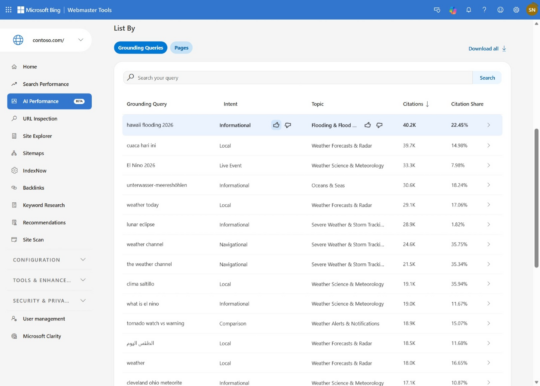
Image Source: Microsoft
As per Microsoft, “Today, we are excited to expand that foundation with four new capabilities available in preview globally within Bing Webmaster Tools: Intents, Topics, Citation Share, and Compare.”
New Metrics of Bing Webmaster Tools:
The AI Performance report initially focused on showing where a website’s content appeared as a citation in AI-generated answers. However, the latest enhancements build on that foundation by introducing additional layers of analysis.
- Intents: The Intents feature categorizes grounding queries based on user objectives, such as informational, navigational, commercial, local, research, or content creation-related requests. This allows publishers to better understand the purpose behind the AI interactions that reference their content.
- Topics: The Topics report groups related queries into broader subject areas, enabling site owners to identify themes that are generating visibility. Instead of assessing one query at a time, it maps similar topics into a broader topic, offering a more natural approach to evaluating AI visibility. This metric helps identify emerging opportunities.
- Citation Share: It provides a competitive view by showing the percentage of citations a site receives for a particular query relative to other cited sources. Microsoft sets this capability as an observational metric that offers a dynamic approach to assessing visibility across AI-generated experiences. Since citation patterns change with the evolving user behavior and models, Citation Share is capable of analyzing that change.
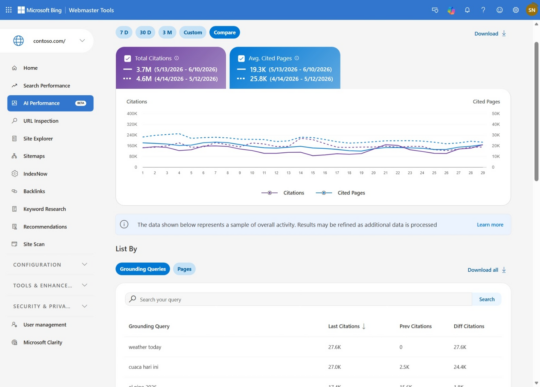
- Compare: The new Compare feature allows users to evaluate data across different time periods. The metric makes it easier to identify gains or declines in AI visibility and assess the impact of content or optimization efforts. Whether it is content update, changing demand, or seasonality, the new metric helps publishers compare it all.
Source: Microsoft
Availability of Bing Webmaster Tools’ New Metrics:
The new metrics are being rolled out globally in preview through the AI Performance section of Bing Webmaster Tools. The dashboard itself debuted in public preview earlier this year as Microsoft’s first dedicated effort to provide citation-level reporting for AI-generated answers.
Microsoft has also incorporated feedback mechanisms into the dashboard, allowing users to share observations and suggestions as the company continues to refine the feature set.
Does the update reflect Microsoft’s Response to Rising AI Search?
As per Microsoft, the enhancements reflect the growing complexity of AI-powered search experiences. AI-generated answers often synthesize information from multiple sources, making visibility harder to measure through conventional analytics tools.
Microsoft understands that publishers require more nuanced reporting to understand how their content contributes to AI responses. It has also become crucial to assess how users are discovering information through conversational interfaces. The new metrics are intended to observe and address this change in search by providing actionable insights into content performance within AI ecosystems.
Keep up with every major tech insight and breakthrough with WisdomPlexus!
Also Read:
SERP features: Guide for Beginners
What is Keyword Difficulty? How to Measure It
Google Retires Web Vitals Extension: Say Hello to DevTools Integration