

The world is moving digitally, and companies that go through cloud migration enjoy a competitive advantage, which is scalability, cost-effectiveness, and enterprise-level security. But how do you navigate this transition smoothly?
Cloud migration is not about moving data; it is a strategic plan that companies create to move their applications and data from an on-premises architecture to the cloud. Whether you are a startup company or an enterprise, understanding the process and types of migration helps to get success.
Why Migrate to Cloud?
-
- Cost Efficiency- Do payment for what you use
- Scalability- Instantly adjust resources as needs change
- Security- Enterprise-grade protection & compliance
- Innovation- Access to AI, analytics & cutting-edge tools
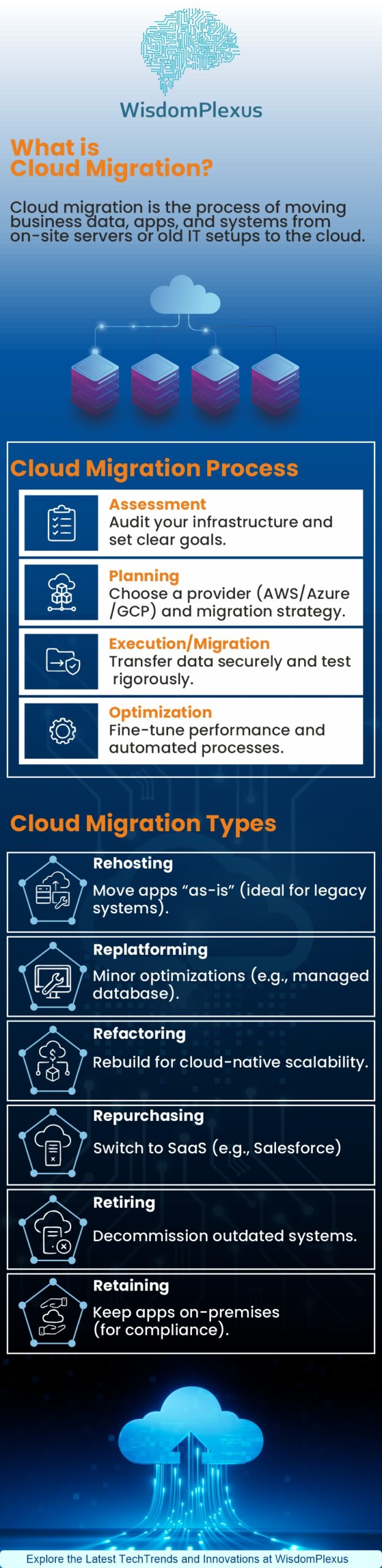
Cloud Migration Process
A successful migration requires careful planning, execution, and optimization. Here’s a breakdown of the four critical stages:
1. Assessment
Start by auditing your existing IT infrastructure to identify dependencies, prioritize workloads, and set clear migration goals.
-
- Audit current infrastructure
- Identify workloads to migrate
- Set clear goals (cost reduction? Performance boosts?)
2. Planning
Choose a cloud provider aligned with your business needs and select the right migration strategy. Develop a robust framework for security, compliance, and disaster recovery.
-
- Choose cloud provider (AWS/Azure/GCP)
- Select migration type
- Build security & compliance framework
3. Migration/ Execution
Transfer data and applications securely, using tools and methodologies tailored to your chosen strategy. Rigorous testing ensures minimal downtime and seamless functionality.
-
- Transfer data & applications
- Test performance rigorously
- Train teams on new tools
4. Optimization
Post-migration, continuously monitor performance, fine-tune configurations, and implement automation to maximize efficiency and cost savings.
-
- Monitor usage & costs
- Fine-tune configurations
- Implement automation
Six Types of Cloud Migration
Every business is unique, and so is its path to the cloud. Here are six common migration approaches:
1. Rehosting (“Lift & Shift)
Move applications “as-is” to the cloud. Ideal for legacy systems and quick, low-risk migrations.
-
- Move apps as-is to cloud
- Best for: Quick wins, legacy systems
2. Replatforming ("Lift, Tinker & Shift")
Make minor optimizations to leverage cloud-native features, such as migrating a database to a managed service.
-
- Minor optimizations for cloud
- Example: Moving a database to managed services
3. Refactoring (Cloud-Native)
Rebuild applications from scratch to fully exploit cloud scalability and performance. Best for long-term innovation.
-
- Rebuild apps for cloud scalability
- Best for: Long-term innovation
4. Repurchasing
Transition to cloud-based Software-as-a-Service (SaaS) solutions like Salesforce or HubSpot for standardized business functions.
-
- Switch to cloud-native SaaS (e.g., Salesforce)
- Ideal for: Standard business apps
5. Retiring
Identify and decommission obsolete applications to reduce costs and simplify your IT landscape.
-
- Decommission obsolete systems
- Why? Cut costs & reduce clutter
6. Retaining
Keep certain applications on-premises due to compliance requirements, unique dependencies, or strategic reasons.
-
- Keep some apps on-premises
- When? For compliance or unique needs
Cloud migration is no longer a luxury, it is a necessity for businesses aiming to thrive in the digital age. By understanding the process, selecting the right strategy, and leveraging expert insights, organizations can navigate this journey with confidence and clarity.
For more such informative content, visit WisdomPlexus!
You May Also Like To Read: