

Say goodbye to manual configuration errors and embrace a future where zero-touch technology automates deployment, seamlessly supporting your IT infrastructure. Automation has gone beyond becoming a trend to a norm across technological and non-technological firms. And zero touch technology has been a key strategy in this regard.
According to sources, the global zero trust provisioning industry is valued at $3.8 billion in 2024, which is expected to go beyond $10.5 billion by 2035. Such measures show how companies, looking for an automated process, are prioritizing zero-touch tech.
This blog will explore zero touch technology, its importance in businesses, and discover key strategic methods to integrate zero-touch tech. Let’s get started...
What is Zero Touch Technology?
Zero touch technology (ZTT) refers to systems, such as devices, apps, or services, that can configure, secure, and update themselves with little or no human intervention. Think of it as plug-and-play deployment at scale, such as when a new laptop, router, or SaaS account arrives. These connect to the network and automatically apply the company’s settings and policies without an IT technician on-site.
This approach reduces repetitive work and makes operations predictable and consistent. While integrating ZTT, two aspects bear significant significance: zero-touch provisioning and zero-touch deployment. These ensure the successful integration of zero-touch tech.
-
- Zero-Touch Provisioning (ZTP)
Zero-touch provisioning (ZTP) is the practical method of implementing ZTT. It boots a device, calls for a provisioning service, receives its configuration, and becomes production ready. ZTP typically uses secure bootstrapping, orchestration services, and cloud-hosted templates, so hundreds or thousands of endpoints roll out with one command.
The outcome is faster onboarding, fewer configuration errors, and simpler scaling. Real implementations of ZTT extend from network appliances to laptops and IoT devices.
-
- Zero-Touch deployment (ZTD)
Zero-touch deployment indicates the successful deployment of the automated framework. It assesses key deployment metrics and ensures the deployment pipeline is auditable, secure, and easy to operate. Though it is the final stage of ZTT implementation, it analyzes its reliability, chances for repeatable rollouts at scale, fewer configuration errors, and faster time-to-productivity for users.
Importance of Zero Touch Technology:
As organizations become increasingly tech-driven, sustaining innovation in operations has become a must. Zero touch technology, in this regard, offers an innovative and strategic approach to automate processes, ensuring utmost security. Here are the top benefits to discuss-
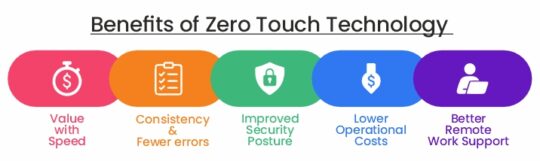
Value with speed: ZTT enables rapid onboarding of staff and devices, which shortens the time for productivity.
Consistency and fewer errors: It offers standardized configs leading to fewer misconfigurations and related breaches.
Improved security posture: Auto-patching, policy enforcement, and identity checks of zero-touch tech reduce exposure windows.
Lower operational costs: Its less manual involvement frees IT to work on higher-value projects.
Better remote work support: Remote and hybrid teams get secure with ZTT implementation. It offers ready devices without shipping back and forth.
Strategic Methods to Implement Zero Touch Technology:
Construct an implementation plan:
Primarily, IT teams need to develop a strategic plan alongside a change management plan so that all processes continue running without disruption. For this purpose, assessing existing workflows, determining areas for automation, and defining goals for implementation will be beneficial. Alongside that, training the workforce is also important in the new process.
This approach offers a clearer vision of why, what, and how to implement ZTT.
Start with inventory and policies:
Understand every device and define the rules it must adhere to. Inventory is the single base of effective automation. In this regard, policies are the “how-to” for configuration, security, and apps. You can’t automate what you don’t know. A solid inventory prevents unwanted situations and ensures every automated deployment integrates with the right configuration.
Identify what to automate:
Organizations need to identify which areas and processes they want to automate. Most preferable areas include those that require higher efficiency but with minimal human intervention. Ensure that a device process is ready and compatible before it gets configured. Issuing unique device identities can be helpful for this purpose.
Integrate Necessary tools and technologies:
Zero touch technology needs the implementation of appropriate tools and technologies to manage processes and governance. Additionally, remote management is a foremost need that requires efficient monitoring tools. These tools further enable endpoint screening, secure accessibility, and continuous activity tracking.
Automated setup software, secure access manager, and update monitor are the key technologies firms must adopt.
Deploy and monitor:
Run pilot projects first to test and identify errors and shortcomings in the process. Following that, initiate the entire deployment. Continuous monitoring is unignorable after the deployment. It helps improve the framework and aim for scalability.
IT, Automation, and Beyond...
Zero touch is part of a broader shift in automation, moving from tool-level scripts to policy-driven operations. It’s not just an IT convenience; when done thoughtfully, it becomes a resilience strategy that supports secure growth, remote work, and faster innovation.
It is surely going to revolutionize the future of businesses, offering opportunities to operate efficiently and autonomously. Do not forget to read our in-depth blogs for unmatched tech insights.
FAQs:
1. What is the zero touch principle?
Ans: Zero touch technology follows the principle of monitoring networks and services and acting on faults with minimal human intervention.
2. What is zero touch automation?
Ans: Zero-touch automation is the process of managing tasks autonomously using appropriate tools and software.
3. What is zero trust vs zero touch?
Ans: Zero trust is a security framework in which all users and devices accessing specific datasets are considered untrusted. On the other hand, zero touch is a method to drive organizational efficiency through automation and minimal human intervention.
Recommended For You:
Know More about Service Automation and its various Examples
Artificial Intelligence Security Issues You Need To Be Aware Of