Welcome to ExtraMile by WisdomPlexus, your go-to interview series offering insights and inspiration from the front runners in the tech industry! It’s your best chance to gain wisdom from the brightest minds shaping tomorrow’s future!
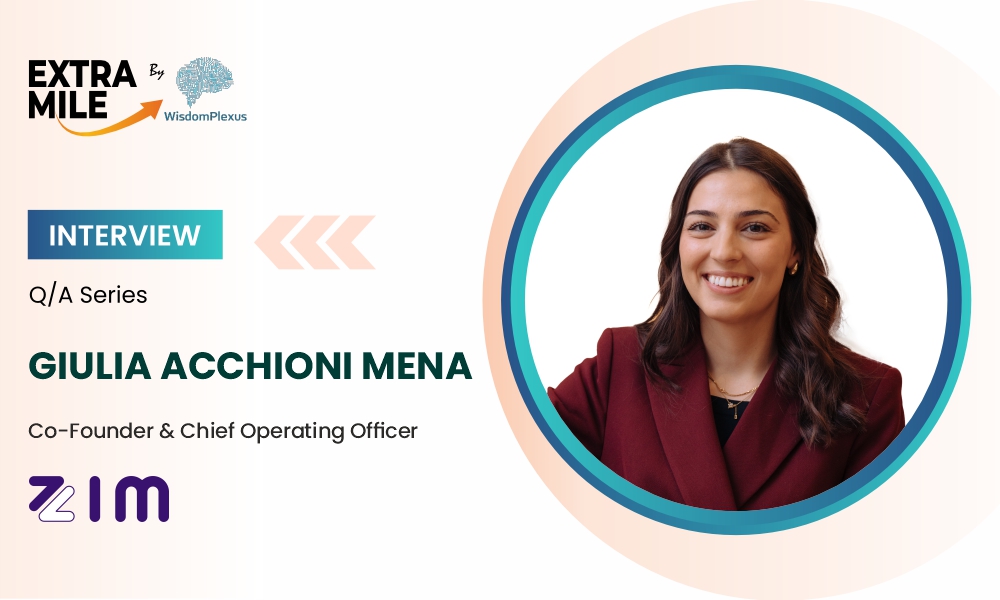
So, to take our latest session forward, we’re thrilled to be joined by Giulia Acchioni Mena, Co-Founder and Chief Operating Officer at ZIM Connections. A global connectivity platform allowing businesses to deliver branded mobile data experiences through eSIM technology.
Giulia brings a sharp lens to international expansion and strategic partnerships. She has been instrumental in growing ZIM’s presence across Europe and beyond!
This conversation is going to be remarkable, as Giulia is here to unpack insights into ZIM’s standout eSIM innovation!
Firstly, Giulia takes us behind the idea of launching ZIM Connections and sheds light on eSIM powering global connectivity. She also shares insights on the importance of data privacy and compliance, collaborations with institutions such as HSBC, and the future of telecom infrastructure.
Indeed, the conversation is packed with insights that all travel enthusiasts shouldn't miss! Giulia, it's a great pleasure to have you on the ExtraMile session. Welcome, let's get started!
Q1. Having lived across different countries and cultures, any specific experience that made you realize connectivity was an issue worth solving?
Giulia. Absolutely. Living and working across different countries, I constantly experienced how fragmented and inefficient connectivity still is. Every trip meant searching for local SIMs, dealing with language barriers, or facing unexpectedly high roaming charges. What struck me most was how something as fundamental as staying connected could still feel so complicated in a world that is otherwise fully digital. That gap between user expectations and reality is what sparked the idea behind ZIM. We saw a clear opportunity to simplify connectivity and make it as seamless as any other digital service.
Q2. Embracing digital transformation and dematerialization has been your core focus. How do you incorporate this philosophy into business decisions?
Giulia. For us, dematerialization is not a buzzword; it is a lens we apply to every decision. Whenever we are evaluating a new feature, a partnership, or an internal process, we ask: where is the friction, and how do we remove it? That thinking led us to build everything around eSIM from day one, to automate onboarding so partners can go live without back-and-forth, and to design activation flows that take seconds rather than days. It also shapes how we build for partners. Our API-first architecture means businesses can integrate connectivity into their own products without taking on any of the underlying complexity. The goal is always to make something that feels inevitable: so simple and seamless that users cannot imagine it working any other way.
Q3. For a long time, launching a travel eSIM service meant heavy infrastructure, complex tech, and more. How does ZIM Connections break each of those barriers, allowing partners to launch a travel e-SIM in just six weeks?
Giulia. Historically, entering the telecom space meant years of investment: building or licensing infrastructure, navigating regulatory requirements in every market, integrating with multiple operators, and maintaining an entire technical stack. We asked ourselves what if we absorbed all of that complexity so our partners do not have to? ZIM acts as a full connectivity layer. We have done the network integrations, handled the compliance, and built the platform. Partners simply connect through our APIs or white-label solution and they are live. What used to take 18 months and millions in upfront investment now takes six weeks. We essentially turned telecom from a barrier to entry into a plug-and-play capability.
Q4. How does ZIM improve travel experience by preventing traditional pain points like SIM switching and roaming charges?
Giulia. The traditional travel connectivity experience is broken in almost every way. Travelers either pay extortionate roaming fees, or land and spend their first hour hunting for a SIM card in an unfamiliar airport. ZIM eliminates both problems entirely. With an eSIM, travelers can purchase and install a plan before they even board the plane and be connected the moment they land. No physical card, no store visit, no bill shock at the end of the trip. Our pricing is transparent and a fraction of standard roaming rates, giving travelers genuine peace of mind from the first minute of their journey.
But the benefits extend well beyond the traveler. For businesses managing employees on the move, ZIM provides a level of control and visibility that simply does not exist with traditional roaming. Companies can centrally manage connectivity across their entire workforce, set usage policies, monitor consumption in real time, and eliminate the unpredictable costs that come with unmanaged roaming bills. Instead of chasing expense reports after the fact, businesses have full oversight from a single dashboard. It turns connectivity from a chaotic, decentralized cost into a structured, manageable resource.
Q5. With access to 200+ destinations, how do ZIM’s eSim travel plans ensure connectivity quality across different regions and networks?
Giulia. Coverage numbers are only meaningful if the quality behind them is real, and that is something we take seriously. We operate through a multi-network ecosystem, which means that in most destinations, our eSIMs are not locked to a single operator. We can connect to whichever network offers the best signal and speed in that location at that moment. We continuously monitor performance data across our network and optimize routing accordingly. This redundancy is what makes the difference between a connectivity product that looks good on paper and one that actually works when you are in the middle of Tokyo, Sao Paulo, or a small town in Eastern Europe.
Q6. Every meaningful partnership makes a difference! How does the collaboration between HSBC Innovation Banking and ZIM Connection boost access to your eSIM solutions for global connection and growth?
Giulia. What excites us about this collaboration is what it represents beyond the partnership itself. It is proof that connectivity is becoming a core component of the business toolkit, not just a travel add-on. HSBC Innovation Banking works with businesses that are scaling internationally, and those businesses need reliable global connectivity to operate. By embedding ZIM’s solutions into their offering, they are able to solve a real operational pain point for their clients, one that previously required piecing together multiple vendors and contracts. For us, it validates our thesis that connectivity belongs inside broader ecosystems: financial platforms, HR tools, travel services. The more embedded it becomes, the more value it creates for everyone.
Q7. Being passionate about a “better and connected tomorrow,” but connectivity comes with a darker side. Do you prioritize ethics in this regard?
Giulia. It is a question we think about deeply. Connectivity is increasingly foundational to how people live and work, which means the responsibility that comes with providing it is significant. We are rigorous about data privacy and operate in full compliance with applicable regulations across every market we serve. But it goes beyond legal compliance. We genuinely believe that trust is the foundation of this business. Our partners trust us with their customers’ data and connectivity experience, and we take that seriously at every level of what we build. We are also mindful that always-on connectivity has real human implications, and we want ZIM to be a platform that enables people, not one that exploits attention or compromises privacy.
Q8. As eSIM adoption is gaining momentum globally, how do you see the future of telecom infrastructure ahead?
Giulia. We are at an inflection point. eSIM is accelerating the shift from hardware-defined to software-defined connectivity, and that changes everything: for operators, for businesses, and for users. In the near term, we will see eSIM become the default across devices globally. But the bigger shift is structural. Telecom infrastructure will move away from rigid, operator-centric models toward open, interoperable ecosystems where connectivity is delivered as a service, embedded invisibly into products and platforms. That is a world where businesses of all kinds, from fintechs to airlines to enterprise software companies, can offer connectivity as part of their value proposition without building telecom capabilities of their own. ZIM is building for that future, and we think it arrives faster than most people expect.
Dive Into More Expert Conversations: