

The advancement of contemporary software development relies on flexibility, scale, and resilience. In contrast to monolithic designs, a microservices ecosystem dissects applications into small, independent services that communicate easily with each other. This approach increases development, improves fault isolation, and allows accurate scaling.
What is Microservice Ecosystem?
A Microservice Ecosystem is a collection of small, independent services that work together to build a large application.
Building a microservices ecosystem involves creating a flexible and scalable architecture. It makes small independent services work together under one setup. Where each service works on a specific business function, this allows for easier development, deployment, and maintenance.
But how to build a robust strong microservice ecosystem? It is not about writing code; it is all about designing, deploying, and managing services efficiently. To make sure about security, monitoring, and smooth communication
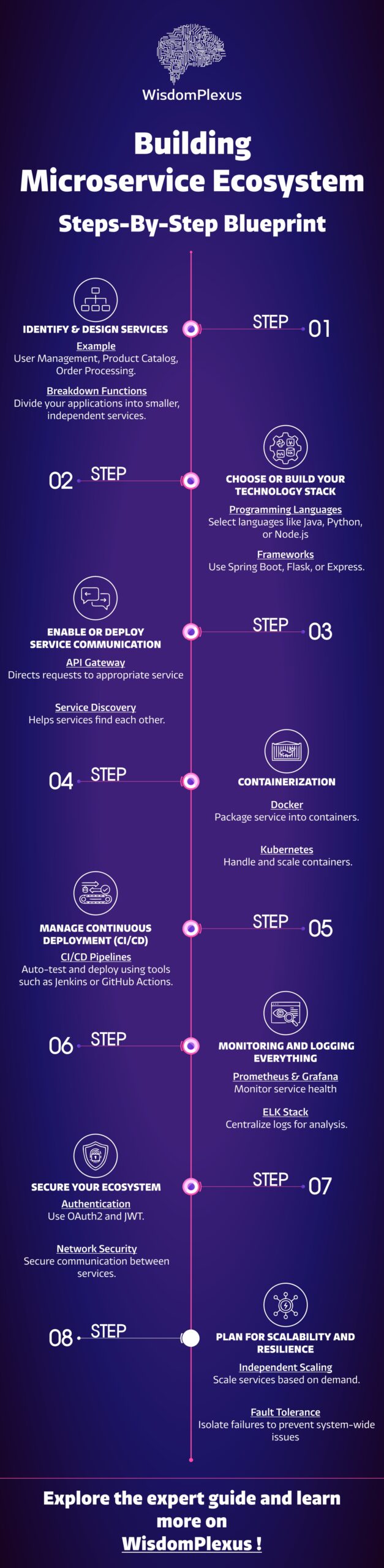 As a startup or enterprise, knowing the essential pieces of a microservices ecosystem allows you to create future-proof applications.
Why Adopt a Microservices Ecosystem?
-
- Scalability: Based on demand, scale individual services independently.
- Faster Development: Teams work on different services simultaneously.
- Resilience: Failures in one service don’t crash the entire system.
- Tech Flexibility: Use different programming languages & frameworks per service.
- Easier Maintenance: Update or replace services without affecting others.
A microservices ecosystem allows businesses to innovate faster, scale effortlessly, and maintain robust applications. By combining the right tools and best practices, you can create a future-proof architecture that adapts to evolving needs.
Explore the expert guide and learn more on WisdomPlexus!
You May Also Like To Read:
Cloud Migration: Process and Types Explained
Microservices vs. Web Services: How the two Software Development Architecture Differ?