
ExtraMile by WisdomPlexus stands amongst the leading and globally acclaimed interview series showcasing the inspiring stories of business leaders, serial entrepreneurs, and innovators. We aim to make tech easy and adaptable for individuals and aspiring leaders. We empower them to stay ahead of emerging technology trends and get prepared for the digital future.
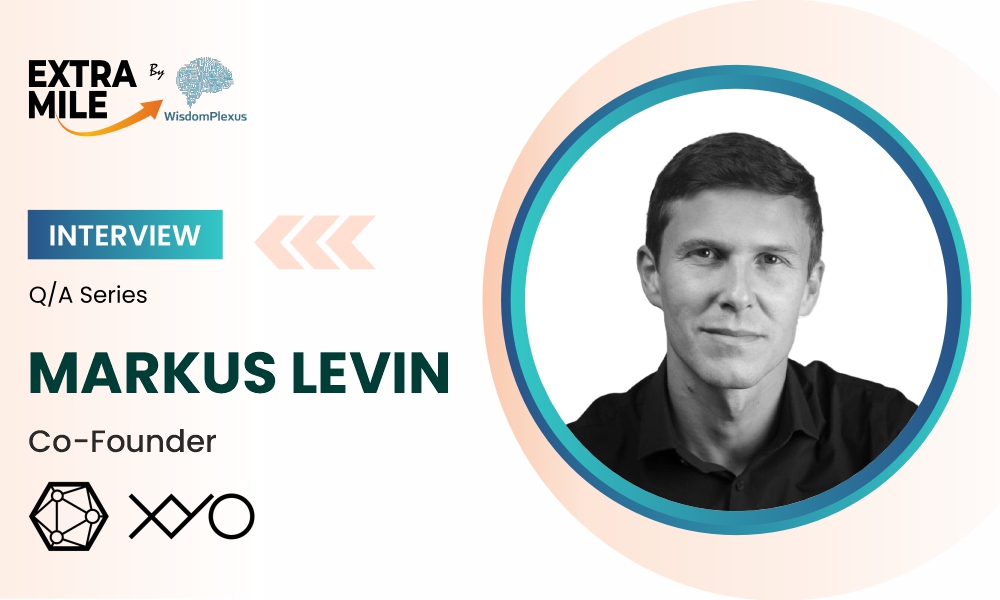
For today’s discussion, we’re ecstatic to have the dynamic Co-Founder of XYO, Markus Levin. The firm is a pioneer in decentralized data networks focused on verifying and authenticating real-world data for AI, supply chain, and next-generation digital systems.
Markus holds over 15 years of experience in building and scaling high-growth technology ventures. He has been at the forefront of the blockchain space since mining his first Bitcoin in 2013.
In today’s spotlight conversation, Markus shares his entrepreneurial journey and the evolution of blockchain. He further highlights the XYO Layer One architecture, the rise of DePIN and DePAI, the growing importance of trusted data in AI-driven ecosystems, and more.
Welcome, Markus! We are delighted to have you with us today!
1. Mining your first Bitcoin in 2013, when blockchain technology was largely experimental, is impressive. How did this early exposure impact your vision for blockchain innovation and entrepreneurship?
Markus. The borderlessness and peer-to-peer-ness of Bitcoin was what was so attractive to me. It felt like a bunch of hippies who believe in the oneness of humanity. We wanted to build systems for all humankind and take back some control. Bitcoin and blockchain technology was the system which would allow that.
Till today, I still hold those values for our industry. We are here a few years later, rebuilding global financial infrastructure and how commerce functions. Nobody thought that the hippies from 2009 to 2013 have not only acolides all over the world, but are well presented in mega corporations (who we wanted to change) and are represented heavily even in government.
Blockchain innovation allows us to build on a global main frame of shared innovation, like decentralization and immutability to enhance our collective opportunities to build better together, be it via DAOs, foundations or within corporations. They all do their part.
In 2013, nothing felt institutional. There were very few exchanges, very little infrastructure, and most people outside a small technical circle dismissed Bitcoin entirely. Mining at that stage forced you to understand how the system actually worked, not just as an investment but as distributed infrastructure. You saw how incentives, cryptography, and network effects combined to create something resilient without central coordination.
That early exposure shaped how I think about building. Blockchain is not interesting because it is new. It is interesting because it allows independent actors to coordinate around shared rules without relying on a single authority. If you are building on it, you have to design around incentives, adversarial behavior, and real-world constraints from the beginning. That mindset carried directly into XYO.
2. Being adept at implementing data-driven solutions within organizations, how does this strategic data-centric decision-making support the scaling of high-growth tech ventures?
Markus. Scaling a high-growth company without disciplined data thinking usually leads to blind spots. You expand faster than you understand your own system. Data-driven decision-making does not mean dashboards everywhere. It means understanding which signals actually matter and ensuring they are trustworthy.
In our case, working with distributed computing and later with decentralized data networks made it clear that raw data is not enough. You need validated data, traceable data, and data tied to identity. When you scale with that foundation, you are not constantly correcting for unknown errors in the system. That reduces friction and improves capital efficiency over time.
3. What key issues is XYO aiming to solve in today’s blockchain ecosystem? What makes it stand out from existing blockchain platforms?
Markus. A major issue in blockchain today is that many applications still depend on unverified external inputs. Smart contracts are deterministic, but the data they rely on is often not. If the data is flawed, the result is flawed.
XYO focuses on validating and verifying real-world data before it becomes part of a blockchain-based decision. We started with location because it is easily spoofed and increasingly valuable. Over time, we expanded into broader proof-of-origin models so that you can trace where data came from, how it moved, and where it ended up.
What differentiates us is that we are not only a blockchain. We are a data verification network with its own Layer One built specifically to act as a center of truth for that data. The emphasis is on authenticity first, settlement second.
4. How does XYO Layer One use AI agents and DePAI to improve data authenticity and reduce AI hallucinations?
Markus. AI systems depend on input quality. When the underlying data lacks provenance or verification, the model can produce confident but incorrect outputs. Hallucination is often a data problem before it is a model problem.
XYO Layer One anchors data with Proof-of-Origin and validation mechanisms before it feeds into AI workflows. AI agents can reference verifiable data sources, not just scraped or aggregated information with unclear lineage. In decentralized physical AI networks, or DePAI, the infrastructure is designed so that compute, storage, and data collection are independently verifiable.
The goal is not to eliminate error entirely. It is to reduce ambiguity about what the AI relied on and to make its inputs auditable.
5. Governance plays a key role in ecosystem stability. What major role does governance play in the XYO token economy?
Markus. Governance in a decentralized ecosystem is about balancing adaptability with stability. If governance is too rigid, the network cannot evolve. If it is too loose, it becomes unpredictable.
In the XYO token economy, governance influences parameters such as incentives, staking models, and ecosystem development priorities. It ensures that participants who contribute value, whether through data collection, validation, or development, have alignment with the long-term health of the network.
Effective governance is less about constant voting and more about maintaining credible rules that participants can rely on.
6. How is network security achieved through XYO’s staking and reward mechanisms? Please share more insights on this aspect.
Markus. Security in our network is tied to economic incentives. Participants who contribute to validation, storage, and data processing are rewarded, but they also have stake at risk. That alignment discourages malicious behavior because attacking the network undermines the value of their own position.
Staking creates commitment. It signals that a participant is invested in the network’s integrity. Rewards are structured around useful contributions rather than passive holding. The objective is to incentivize honest behavior at scale while making coordinated manipulation economically irrational.
7. Why is trusted data important for industries like AI and gaming? How does it impact accuracy, performance, and overall results?
Markus. In AI, the quality of output is directly tied to the quality of input. If training or inference relies on corrupted, spoofed, or poorly sourced data, the system’s performance degrades, AI hallucinates. That affects everything from predictive accuracy to safety.
In gaming, especially in location-based or asset-driven ecosystems, trust determines fairness. If players can spoof location or manipulate event data, the integrity of the experience collapses. Trusted data ensures that outcomes reflect actual behavior rather than exploits.
Across both industries, verifiable inputs reduce disputes, improve reliability, and create systems that scale without constant manual oversight.
8. What are the most significant barriers organizations face when moving from traditional business models to blockchain-driven ecosystems?
Markus. The primary barrier is not technical. It is structural and cultural. Traditional organizations are accustomed to centralized control and internal reconciliation processes. Blockchain systems introduce shared state, transparency, and different incentive dynamics.
There is also a misconception that blockchain automatically creates efficiency. In reality, poorly designed token models and governance structures can introduce new complexity. Organizations must rethink identity, data ownership, compliance, and revenue flows.
The transition works best when blockchain is applied to a specific coordination problem rather than used as a blanket replacement for existing systems.
9. Looking ahead, how does the future of blockchain and Web3 look? What innovations and trends will drive its growth?
Markus. The future of blockchain will likely be less visible but more integrated. As infrastructure matures, users will interact with applications without thinking about the underlying chain. The focus will shift toward data authenticity, decentralized physical infrastructure, tokenized real-world assets, and AI-integrated systems.
Growth will come from practical utility rather than speculation. Networks that solve tangible coordination or verification problems will endure. The next phase is not about creating more tokens. It is about building systems that can operate at scale in real-world environments.
Dive Into Another Expert Conversation:
